
Why Government & Public Institutions in Accra Build With Construct GH
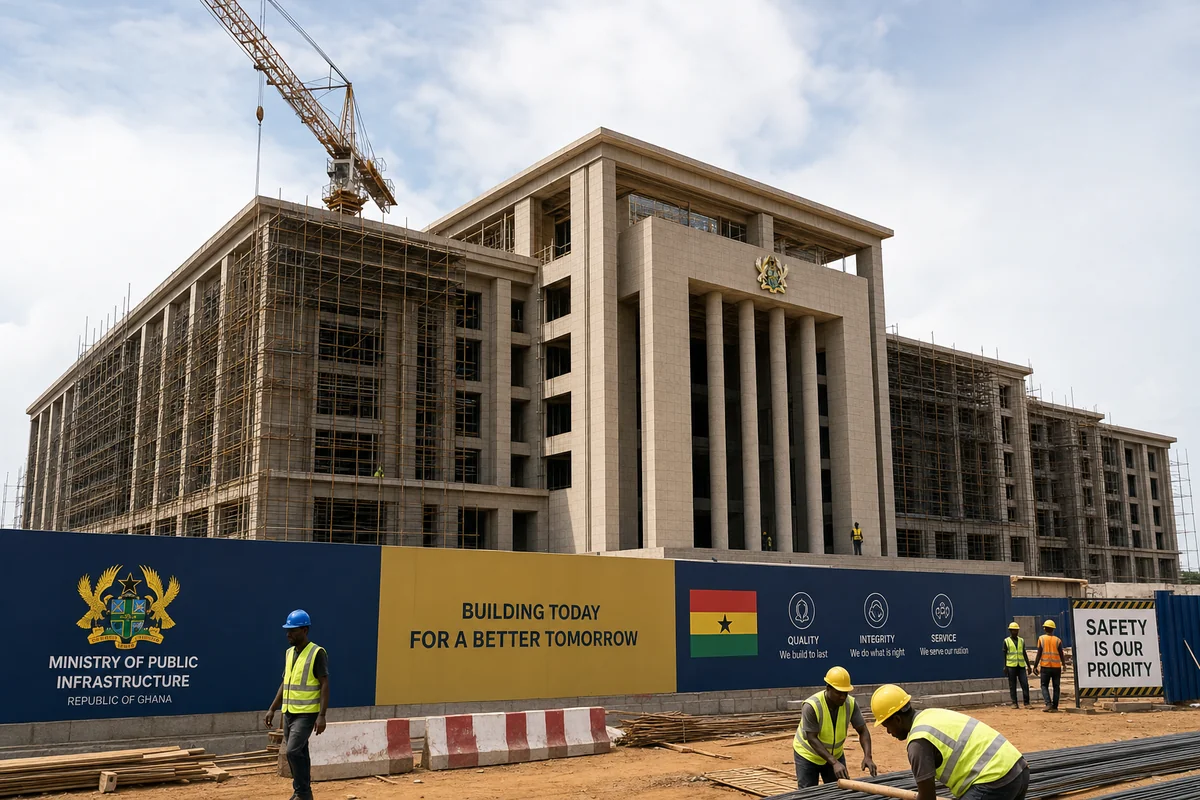
A government or public-institution building is procured under rules, not relationships — and the contractor who wins it has to prove classification, price on a measured Bill of Quantities, and document every stage for the auditors who will review the award long after handover. A ministry, an agency headquarters, or a civic building also carries an obligation beyond the functional: it must project permanence and the dignity of the institution it houses, on a budget signed off with public money. Construct GH has built commercial and institutional projects in Accra since 1977 — the kind of track record a public-procurement evaluation panel can verify rather than take on trust.
Public-sector clients commit on cost certainty and compliance above all. Public money is audited, so an estimate that drifts once site starts is a finding waiting to happen. Construct GH prices a public-institution project on a measured Bill of Quantities and delivers the method statement, programme, and stage records a procurement file requires — so the award is defensible and the build is accountable.
What Government Projects Demand
Public-Procurement-Ready Documentation
Public tenders are won on documents before they are won on price. Construct GH submits a tender-ready Bill of Quantities, a method statement, a realistic programme, and the contractor-classification evidence a procurement panel checks — the full file a public-sector evaluation requires, prepared to the standard the Public Procurement Authority framework expects.
Compliance Documented at Every Stage
A public award is audited from origin to handover. We maintain stage quality records, HSE documentation, certificates, and as-builts across the programme, so the institution can close out a procurement audit cleanly and answer to oversight bodies with a complete file.
Built to Code, Built to Last
Civic and institutional buildings serve the public for decades. We build to the Ghana Building Code (GS 1207:2018) and the regulations (L.I. 1630), with registered professional input, and stand behind it with a written warranty and a defects-liability period — durability the public purse is entitled to expect.
Our Government Construction Scope
Construct GH delivers public-institution projects from a single accountable team — tender, permits, procurement, every trade, HSE, and handover:
- Commercial Construction in Ghana — institutional and civic builds delivered procurement-ready
- Commercial Office Towers — ministry and agency headquarters delivery
- Project Management for Construction — a managed programme with progress and cost reporting
- Tender & Procurement Readiness — the measured BoQ, method statement, and classification a public tender requires
Credentialed & Classified
A public-procurement panel awards only to a contractor it can verify on paper. Construct GH carries the credentials a public-sector evaluation checks:
- Builds to Ghana’s building regulations (L.I. 1630) and the Ghana Building Code (GS 1207:2018)
- Registered engineering (GhIE / Engineering Council) and quantity-surveying (GhIS) input on every project
- Ministry of Works & Housing financial (D) and works (K) contractor classification shared on request
- EPA permitting (L.I. 1652) handled where the project requires it
- Whole-build cost on a measured Bill of Quantities — never a per-square-metre guess
Capability & Tender-Readiness
A public-sector procurement begins with a complete tender file, not a phone call. Construct GH provides a capability statement and a tender-ready Bill of Quantities for your specific scheme — with the method statement, programme, and classification evidence a procurement panel evaluates — so the award rests on measured cost, compliance, and a programme we can hold. Request the capability statement to begin.
Government & Public Institutions Across Accra
Construct GH builds ministries, agency headquarters, and civic facilities across Ridge, Airport City, the CBD, and Cantonments — the seat of national institutions — plus Kumasi, Takoradi, and Lomé, Togo, for public and cross-border institutional clients.